


How to Choose the Best Commercial Dough Mixer for Your Kitchen
Last Updated: November 8, 2026
Quick Summary
Choose a commercial dough mixer by working backward from the dough weight you need per shift, then checking rated capacity at your hydration, since low-hydration doughs like bagel sharply reduce what a machine can handle. Pick the smallest machine that covers your busiest shift with headroom, and match motor size and electrical service to your stiffest dough.
- A mixer rated for 133 lb of bread flour at 65% hydration yields roughly 220 lb of dough.
- The same machine rated for bagel flour tops out near 109 lb of flour, about 165 lb of dough.
- The 50-quart LM50TETL kneads up to 42 lb and runs on 220V single-phase at 14 amps.
- Buying a 130-quart machine for 40 lb batches leaves the hook unable to reach the dough.
- Factor in electrical work, delivery, rigging, a spare bowl or hook, and downtime cost.
Table of Contents
- What the Best Commercial Dough Mixer Gets Right
- Commercial Dough Mixer 60 Qt and Larger: Matching Bowl Size to Batch Size
- Small Commercial Dough Mixer Options for Lower-Volume Kitchens
- Picking the Mixer That Fits Your Production Line
- Frequently Asked Questions
What the Best Commercial Dough Mixer Gets Right
A commercial dough mixer kneads, folds and develops dough at production scale. The best ones match bowl capacity to your real batch size, hold up under stiff dough, and repeat the same mix every time.
The most common mistake is buying on bowl size alone: flour weight, hydration and dough type decide what a machine can actually handle.
Motor sizing must match dough stiffness, since low-hydration bagel dough places far more load on a motor than higher-hydration bread dough.
If you want to see the full range of machines that meet these criteria, you can browse commercial dough mixers by capacity and type.
Commercial Dough Mixer 60 Qt and Larger: Matching Bowl Size to Batch Size
Large-format mixers are where sizing mistakes get expensive: the difference between a 130-quart and 150-quart bowl is measured in dough you can sell.
Start from the dough weight you need per shift, work backward to flour weight, then check rated capacity at your hydration. A mixer rated for 133 lb of bread flour at 65% hydration produces roughly 220 lb of dough; the same machine rated for bagel flour tops out near 109 lb of flour, or about 165 lb of dough.
| Model | Bowl Capacity | Rated Dough Capacity | Power Requirement | Price |
|---|---|---|---|---|
| Hobart HSL180-1 | 150 qt | 180 lb | 208V, 3-phase, 34.5 amps | $39,583.16 |
| Empire EMP-IRIS-100 | 130 qt | 220 lb bread / 165 lb bagel | 2-speed spiral and bowl drive | $19,844.16 |
| Doyon AEF035SP | Fixed stainless bowl | 120 lb | 2-speed, programmable | $21,403.00 |
Price
The Hobart HSL180-1 is the heaviest machine here, with dual electronic timers, reversible bowl drive and bowl jog control. See the Hobart HSL180-1 180 lb fixed-bowl spiral mixer for full specs.

The Empire EMP-IRIS-100 offers a 130-quart stationary bowl, two timers with automatic low-to-high changeover and reversible bowl rotation. Check the Empire EMP-IRIS-100 spiral mixer for the bagel and bread flour ratings side by side.

Watch out: buying a 130-quart machine for 40 lb batches means the hook never reaches the dough properly, and no timer adjustment fixes uneven mixing.
Small Commercial Dough Mixer Options for Lower-Volume Kitchens
A small commercial dough mixer in the 30 to 50 quart range covers pizzerias, cafes, delis and pastry shops that make dough daily but not by the ton, running on single-phase power at a fraction of a production floor unit's cost.
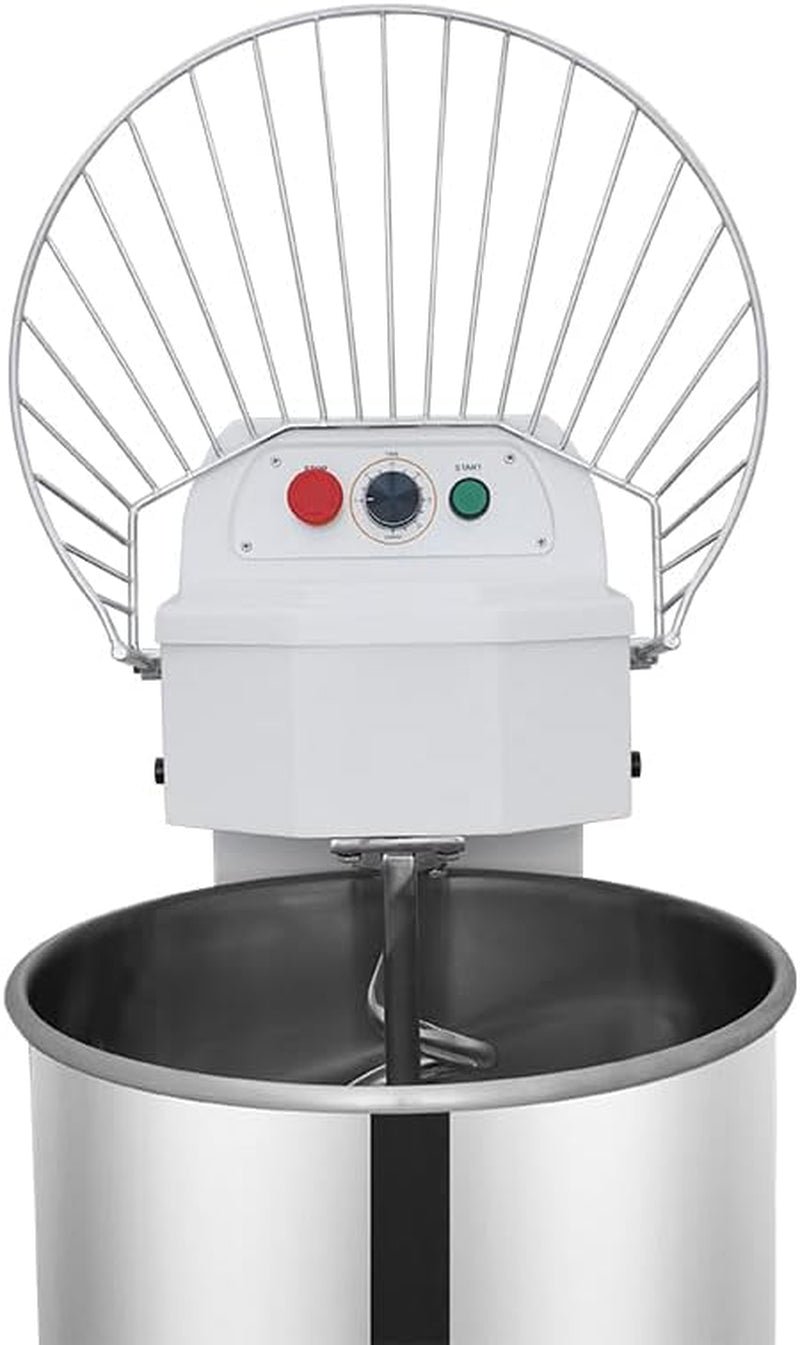
The 50-quart LM50TETL suits many small operations: 42 lb maximum kneading capacity, 185 RPM mixing speed, a built-in timer, 3.08kW on 220V single-phase at 14 amps with a NEMA 6-20P plug, and cETLus certification. View the 50 qt spiral dough mixer for dimensions and the full spec sheet.

For modest volume, a 30-quart gear-driven machine with a 1100W motor, a food-grade 304 stainless steel bowl and three interchangeable attachments is a lower-capacity option. See the 30 qt gear-driven mixer if batches stay under roughly 25 lb of dough.
Also worth knowing: the Doyon AEF025SP at 88 lb dough capacity and the Doyon AEF035SP at 120 lb, both with nine programmable speed and time settings, a 99-minute timer, emergency stop, thermal overload protection, and a wire guard with automatic motor cut-off.
Picking the Mixer That Fits Your Production Line
The right commercial dough mixer is the smallest machine that covers your busiest shift with a little headroom, not the largest one you can afford. Work out peak dough weight per service, add a margin for growth, then match capacity, power and bowl type to that number.
Checklist: peak dough weight per shift; hydration range of your stiffest dough; available electrical service; footprint and door width for delivery; programmable timers versus knob controls; and who services the machine locally, and how fast.
Be honest about your panel. A 208V three-phase, 34.5 amp machine needs an electrician and a spare breaker; a 220V single-phase unit with a NEMA 6-20P plug can often go straight into an existing circuit.
Purchase price is only part of it: factor in electrical work, delivery and rigging, a spare bowl or hook, and the downtime cost of a breakdown during service.
A used commercial dough mixer for sale can be sensible if you can inspect the bowl, hook and gearbox in person and confirm the motor runs under load, but service history and parts availability on an older model are what bite.
That is the whole decision: capacity you can prove, power you can supply, and support you can reach.
Matching a mixer to your production line comes down to three numbers: peak batch weight, available power, and the dough you actually mix. Crestoven stocks commercial dough mixers from 30 quarts to 180 lb floor units, selected for consistent output under real commercial demand, with free shipping on most orders within the continental U.S. and 30-day returns. Get started with Crestoven and size your next mixer against your busiest shift, not your quietest one.
Frequently Asked Questions
What size commercial dough mixer do I need?
Match capacity to your heaviest single batch, not your daily total. A 50-quart spiral mixer like the LM50TETL kneads up to 42 lb of dough, which suits a small pizzeria or cafe. Mid-size shops typically land in the 88 to 133 lb range, such as the Doyon AEF025SP at 88 lb or the Empire EMP-IRIS-100 at 133 lb bread flour. High-volume bakeries running continuous production need a floor model like the Hobart HSL180 at 180 lb. Buy for your busiest day and leave a little headroom.
Is a used commercial dough mixer worth buying?
A used commercial dough mixer for sale can save money, but only if you verify condition first. Ask for the service history, confirm the motor and gearbox have been inspected, and check that the bowl, spiral arm, and guard are free of cracks or deep wear. Test the two-speed operation and timers before payment. Factor in the cost of replacing worn parts, since a cheap mixer that fails mid-service costs more than a new one. If records are missing, price the risk in.
What is the difference between a spiral mixer and a planetary mixer?
A spiral mixer uses a stationary bowl with a rotating spiral arm and breaker bar, which develops gluten efficiently with less heat buildup, . A planetary mixer moves the attachment around a stationary bowl and handles cake batter, icing, and small dough batches. For high-volume dough production, a spiral commercial dough mixer is the better fit. Crestoven's lineup, from the 50-quart LM50TETL up to the 180 lb Hobart HSL180, is entirely spiral design.


