


8 Commercial Pizza Oven Insulation Mistakes That Waste Energy
Last Updated: November 12, 2026
Quick Summary
Energy efficient commercial pizza oven insulation stops heat escaping through the dome, floor and door, and modern ovens with ceramic fiber insulation can cut energy consumption by up to 30% compared to older models. Properly insulated clay domes can save up to 60% on fuel. The key is pairing thermal mass with the right insulation in the right places.
- Ceramic fiber blanket typically runs 1 to 2 inches thick over a commercial oven dome.
- A 2-inch ceramic board layer can drop an 800ºF cooking floor to roughly 170ºF at equilibrium.
- Wrap the dome only after it is fully cured and dry, or trapped steam delaminates the blanket.
- Perlite mix ratio runs roughly 4 to 6 parts perlite to 1 part cement or refractory mortar by volume.
- ENERGY STAR gas convection ovens must hit 49% cooking energy efficiency and a 9,500 Btu/h idle rate.
Table of Contents
- How Insulation Cuts Heat Loss in a Commercial Pizza Oven
- Pizza Oven Insulation Blanket: Where It Goes and How Thick
- Ceramic Fiber Blanket Pizza Oven Installation: Layer Order That Works
- Calcium Silicate Board for Pizza Oven Floors and Base Insulation
- Perlite Pizza Oven Mix Ratio and Vermiculite Alternatives
- Energy Savings, Payback, and Lifecycle Cost on Commercial Ovens
- Commercial Codes, Fire Safety, and Inspection Checklist
- Choosing an Oven With Insulation Built In at Crestoven
- Frequently Asked Questions
How Insulation Cuts Heat Loss in a Commercial Pizza Oven
Energy efficient commercial pizza oven insulation is the single biggest factor separating an oven that holds temperature through a dinner rush from one that bleeds heat and money all night. Operators often upgrade the oven, overlook the insulation spec, and then wonder why gas bills climb while pies come out uneven.
Heat always moves from hot to cold. In a pizza oven, it escapes three ways: through the dome, down through the cooking floor, and out the door. Insulation slows all three. The thicker and denser the barrier, the slower the escape.
The payoff is measurable. Modern commercial ovens with ceramic fiber insulation can cut energy consumption by up to 30% compared to older models, according to Culinary Depot's commercial pizza oven buyer's guide. Properly insulated clay domes can save up to 60% on fuel, per Fuego Wood Fired Ovens.
Thermal Mass Versus Insulation: What Each One Does
Thermal mass is the oven's ability to store heat. Insulation is its ability to keep that heat from leaving. They solve different problems, and confusing them is the most common mistake in oven design.
- Thermal mass: firebrick, refractory material, ceramic clay stones. Absorbs heat during warm-up, releases it during baking. Slow to heat, slow to cool.
- Insulation: ceramic fiber blanket, insulation board, perlite. Slows heat transfer outward. It does not store heat; it stops loss.
A thick firebrick floor with no insulation underneath is a heat sink into your slab. A thin floor with great insulation recovers temperature faster. Most commercial ovens need both, in the right places.
Pizza Oven Insulation Blanket: Where It Goes and How Thick
A pizza oven insulation blanket wraps the dome and, in some designs, the floor. On a commercial oven, blanket thickness typically runs 1 to 2 inches over the dome, with a rigid board layer beneath the cooking floor.
Here's what most guides miss: the blanket does almost nothing if it gets wet or compressed. Ceramic fiber loses insulating value when moisture gets in, and squeezing it flat kills the air pockets that do the work. Keep it dry and keep it loose.
For the floor, a 2-inch layer of ceramic board can drop the temperature of an 800ºF cooking floor to roughly 170ºF at equilibrium, according to Forno Bravo's insulation guidance. That's the difference between a safe, efficient base and a scorched countertop.
Ceramic Fiber Blanket Pizza Oven Installation: Layer Order That Works
Ceramic fiber blanket pizza oven installation follows a fixed layer order on most commercial domes: refractory shell, then blanket, then a rigid outer skin. Get the order wrong and you trap moisture or crush the blanket.
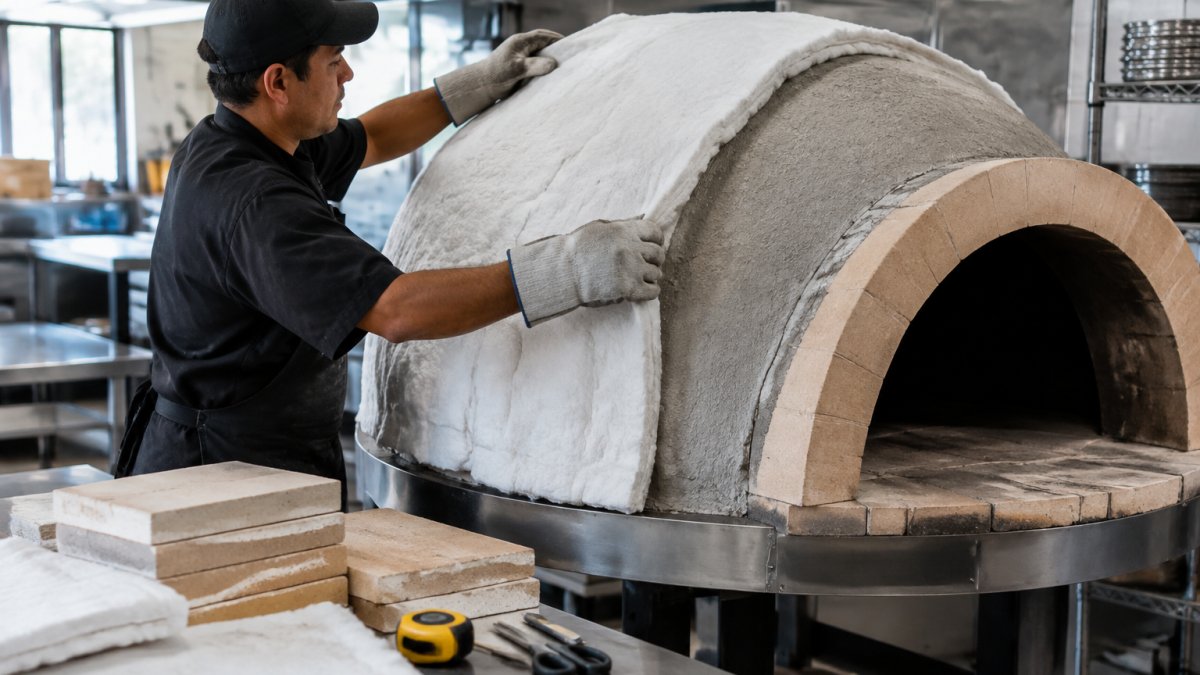
The sequence that works:
- Cure and dry the refractory dome fully.
- Lay the ceramic fiber blanket in overlapping wraps, 2 inches thick.
- Add a second layer if the spec calls for it, offsetting the seams.
- Cover with wire mesh or a rigid board to hold it in place.
- Apply the outer render or metal jacket.
Watch out: sealing a damp dome under blanket traps steam, and the blanket delaminates within weeks. Dry first, wrap second.
Calcium Silicate Board for Pizza Oven Floors and Base Insulation
Calcium silicate board for pizza oven floors is the standard choice under the cooking floor. It's rigid, handles high heat, and resists compression, which ceramic blanket does not.
The board sits between the firebrick floor and the oven base. Two inches is common on commercial builds. It carries the weight of the floor and the pies without collapsing, and it holds its shape for years.
- Best for: floor and base insulation on deck and wood-fired ovens
- Skip if: you need flexibility around a curved dome, where blanket wins
Perlite Pizza Oven Mix Ratio and Vermiculite Alternatives
Perlite pizza oven mix ratio runs roughly 4 to 6 parts perlite to 1 part cement or refractory mortar by volume, depending on the application. The perlite does the insulating; the binder just holds it together. Vermiculite works the same way and is a fine substitute. Both are lightweight, pourable, and cheap. Neither matches a rigid board for floor loads.
On a commercial build, the mix ratio matters less than where you put the material. Perlite and vermiculite are loose-fill and insulating render materials, not structural ones. They excel at filling the irregular voids around a dome, forming a lightweight insulating render over a blanket, and providing base fill under a floor board. They are a poor choice directly beneath a heavy commercial cooking floor, where compressive load and foot traffic will crush the aggregate and collapse the air pockets that provide the R-value.
A practical commercial approach is to treat perlite or vermiculite as the filler, not the foundation:
- Dome voids and haunches: a 5:1 perlite-to-mortar mix packed around the dome adds insulation where blanket cannot follow the curve.
- Insulating render: a 4:1 mix over a ceramic blanket layer adds a second barrier and a surface for the outer skin.
- Base fill: a dry or lightly bound perlite layer under a rigid calcium silicate board, never under the firebrick floor itself.
Watch out: perlite and vermiculite absorb water readily, and a damp mix that never dries will conduct heat instead of resisting it. Cure and dry any perlite-containing layer fully before closing up the oven, and keep the mix away from direct flame contact unless it is bound in a refractory mortar rated for the temperature.
For commercial duty cycles, the material choice should follow the load path. Use calcium silicate board where the floor carries weight, ceramic fiber blanket where the dome needs flexibility, and perlite or vermiculite where you need cheap void fill or a lightweight render. Mixing those roles is where most insulation retrofits lose their performance.
Energy Savings, Payback, and Lifecycle Cost on Commercial Ovens
Most insulation content stops at 'insulation saves energy.' For a restaurant, the useful question is how much, under what duty cycle, and how fast the upgrade pays for itself. That requires a measurement method, not a brochure claim.
Start with a baseline. Pick a representative week and log three numbers daily: total fuel or electricity consumed by the oven (gas meter, submeter, or nameplate-derived estimate), warm-up time from cold start to operating temperature, and recovery time after a defined load (for example, six pies back-to-back). Keep the load and ambient conditions comparable across the before-and-after period. A common pattern is that operators discover their 'insulation problem' is actually a door-seal or vent problem, so measure before you buy.
Then isolate the insulation variable. If you are retrofitting an existing oven, the measurable gains show up in three places: shorter warm-up, faster recovery between bakes, and lower standby loss overnight or between services. Warm-up and recovery are the easiest to quantify because they translate directly into labor hours and open-flame or element-on time. Standby loss is where a well-insulated commercial oven separates from a residential-style build, because a restaurant holds temperature for 10 to 14 hours a day, not two.
Run the payback math with your own inputs rather than a generic percentage:
| Input | How to get it |
|---|---|
| Annual energy spend on the oven | Utility bills or submeter data for one year |
| Achievable savings rate | Measured warm-up and recovery improvement, applied conservatively |
| Installed cost of the insulation upgrade | Material plus labor quote, including any downtime |
| Maintenance change | Fewer seal or blanket replacements over the service life |
A 30% cut in energy use on a busy oven often pays back the insulation upgrade inside a couple of years, but the range is wide. A low-volume oven that runs four hours a day may take far longer, while a high-volume deck oven running two shifts can pay back faster than the table suggests. The EPA's research on the energy-efficiency paradox found that managers often skip efficient upgrades despite clear savings, usually over upfront cost. On a high-volume oven, that hesitation costs more than the upgrade.
Lifecycle cost is the number that actually belongs in a capital request. Add the installed insulation cost, subtract the present value of measured energy savings over the oven's service life, and add back any avoided maintenance. Commercial wood-fired pizza oven equipment was valued at about $160.80 million in 2025 and is projected to reach $172.38 million in 2026, per LinkedIn Pulse's market report, which tells you buyers are paying for efficiency, not just capacity. The insulation spec is where that efficiency is won or lost.
Watch out: savings claims that ignore duty cycle, door-opening frequency, and vent settings will overstate payback. Benchmark under conditions that match your actual service, and re-measure after the upgrade rather than trusting the spec sheet.
If you're still weighing the investment, our guide on whether a pizza oven is worth it for your commercial kitchen walks through the decision.
Commercial Codes, Fire Safety, and Inspection Checklist
Commercial ovens face real rules. ENERGY STAR certified gas convection ovens must hit a cooking energy efficiency spec of 49% and an idle energy rate of 9,500 Btu/h, per ENERGY STAR's commercial oven standards. Wood and coal-fired ovens in some jurisdictions face new emission rules that can require engineering assessments and control devices.
Inspection checklist:
- Clearance to combustibles matches the spec plate
- Insulation is dry and uncompressed
- Door seal closes tight with no gaps
- Vent and flue are clear
- Floor insulation board is intact
- Outer jacket has no cracks or moisture stains
Watch out: a failed door seal undoes good dome insulation. Check it monthly.
Choosing an Oven With Insulation Built In at Crestoven
The simplest way to get insulation right is to buy an oven that already has it. Crestoven's commercial ovens include high-density insulation and sealed walls.
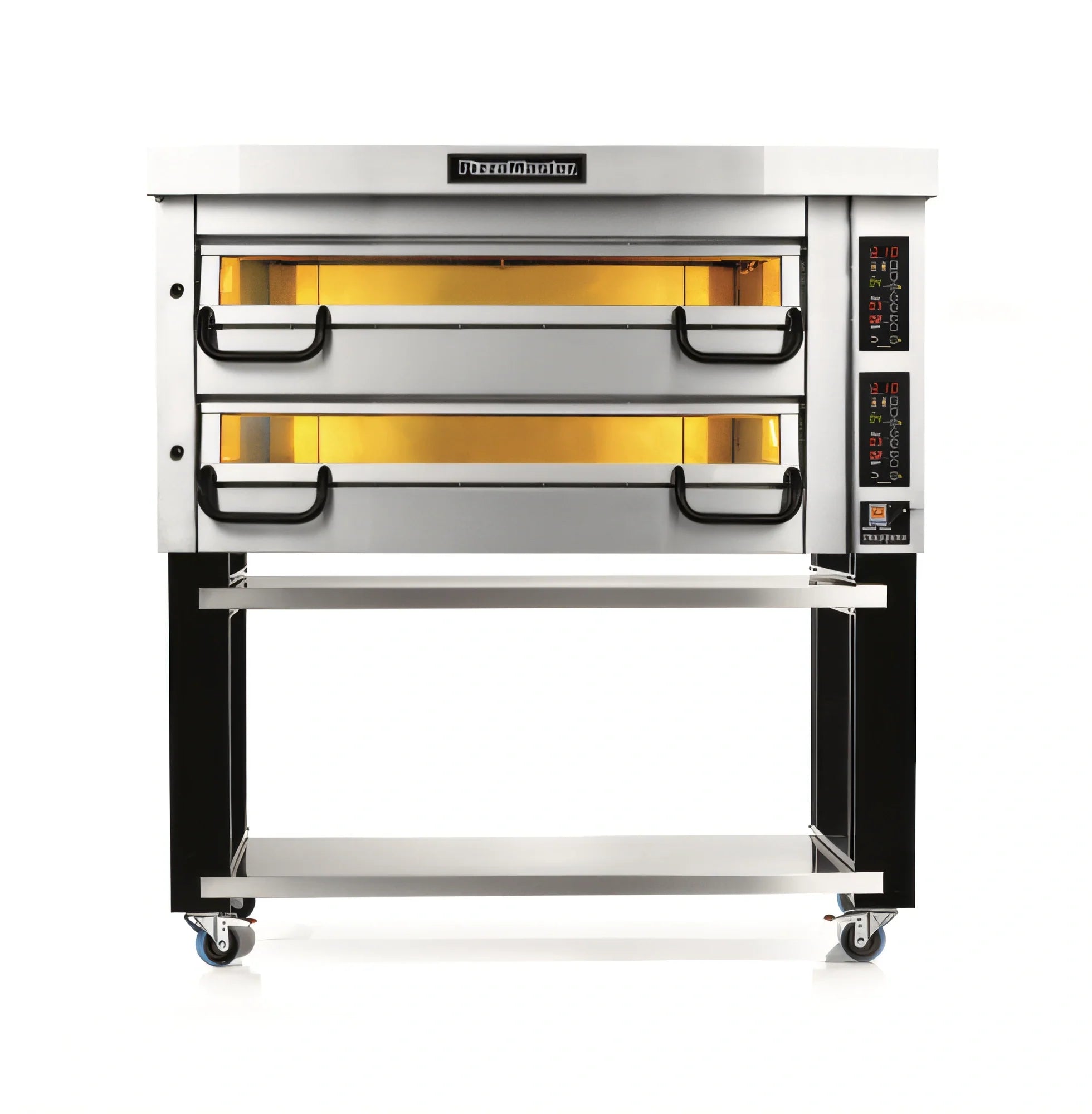
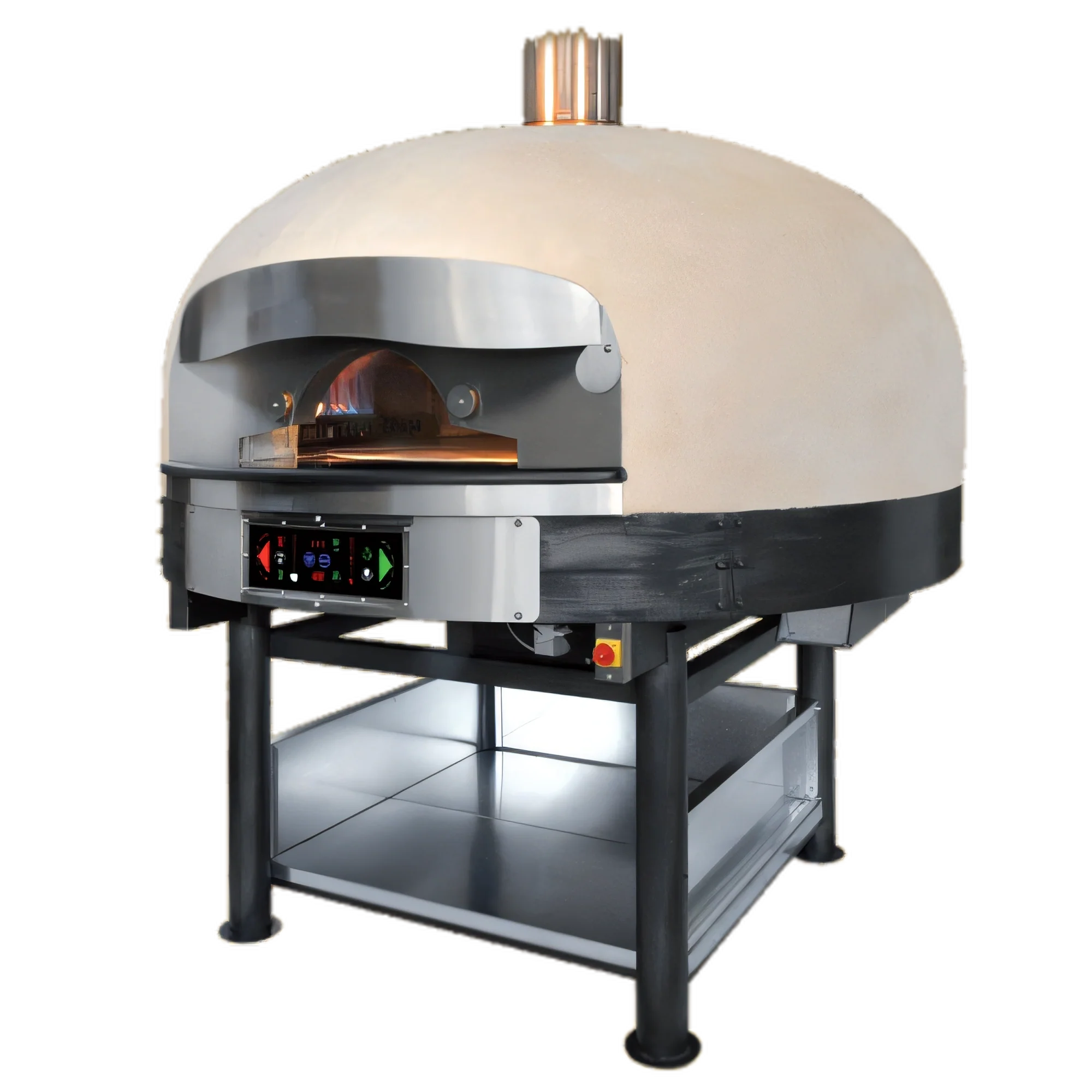
The PizzaMaster PM 842ED two-deck electric oven includes ceramic clay stones, high-density insulation, and TempIQ Recovery. The Morello Forni PG130-CB gas-fired round oven carries 7-inch thick sealed insulated walls. Both are built for high-volume service.
You can browse our commercial pizza ovens, see the PizzaMaster PM 842ED specs, or check the Morello Forni PG130-CB. For temperature control during peak hours, read our guide on pizza oven temperature during dinner rush.
Insulation is the cheapest efficiency upgrade in your kitchen, and the most ignored. If you're tired of watching heat and money leave through the dome, Crestoven can help. Our ovens ship with free shipping on most orders within the continental U.S. and 30-day returns, and our independently owned team is here to match the right oven to your output.
Frequently Asked Questions
What is the best insulation for a commercial pizza oven?
Most commercial ovens combine two or three materials rather than one. Ceramic fiber blanket handles the dome because it tolerates high heat and wraps curved surfaces. Calcium silicate board goes under the cooking floor, where compressive strength matters.
Is a ceramic fiber blanket pizza oven insulation safe to install?
Ceramic fiber blanket is a standard choice for dome insulation, but the fibers irritate skin and lungs during handling. Wear gloves, eye protection, and a respirator, and keep the blanket sealed behind the render or enclosure so fibers never contact food surfaces. Check that the product is rated for your oven's maximum temperature before you buy. Once encapsulated, the blanket sits outside the cooking chamber and does not affect food safety.
What perlite pizza oven mix ratio should I use?
Some builders add a small amount of clay to improve workability. Keep the mix light and crumbly rather than pourable, because too much water reduces insulation value. Verify the ratio against your oven plan before you commit.
How do I insulate a commercial pizza oven under the floor?
The floor assembly usually runs firebrick on top, then a calcium silicate board or a perlite-concrete layer, then the structural base. Calcium silicate board offers predictable thickness and compressive strength, which matters when a commercial deck carries heavy loads all day. Inspect for moisture before sealing the assembly.


