


Pizza Oven Temperature During Dinner Rush: A Guide
Last Updated: November 7, 2026
Quick Summary
Pizza oven temperature during dinner rush is a moving target that drops every time the door opens, so you manage floor, dome, and air readings at once rather than trusting a single dial setting. Take a floor reading every 20 to 30 minutes during service, or after every 10 to 15 pies, whichever comes first.
- Floor temperature sets how fast the bottom sets and browns, while dome temperature drives the top and the char.
- Test recovery time by reading the floor every 30 seconds after a pie comes out, three times in a row.
- In a wood-fired oven, rotate each pie a quarter turn every 15 to 20 seconds.
- A Neapolitan pie wants 800°F to 900°F and a 60 to 90-second bake.
- A drift of 25°F or more from your target means it is time to check the burner, the stone, or the fuel bed.
Table of Contents
- What a Dinner Rush Does to Your Pizza Oven Temperature
- Commercial Pizza Oven Temperature Targets for Peak Service
- Wood-Fired Pizza Oven Temperature and Time Under Load
- Gas Pizza Oven Temperature: Holding Steady When Orders Stack Up
- Pizza Oven Temperature and Bake Time: Matching Heat to Style
- Monitoring and Troubleshooting Uneven Bakes Mid-Service
- Frequently Asked Questions
What a Dinner Rush Does to Your Pizza Oven Temperature
A pizza oven temperature during dinner rush is not the number on the dial at 4 p.m.
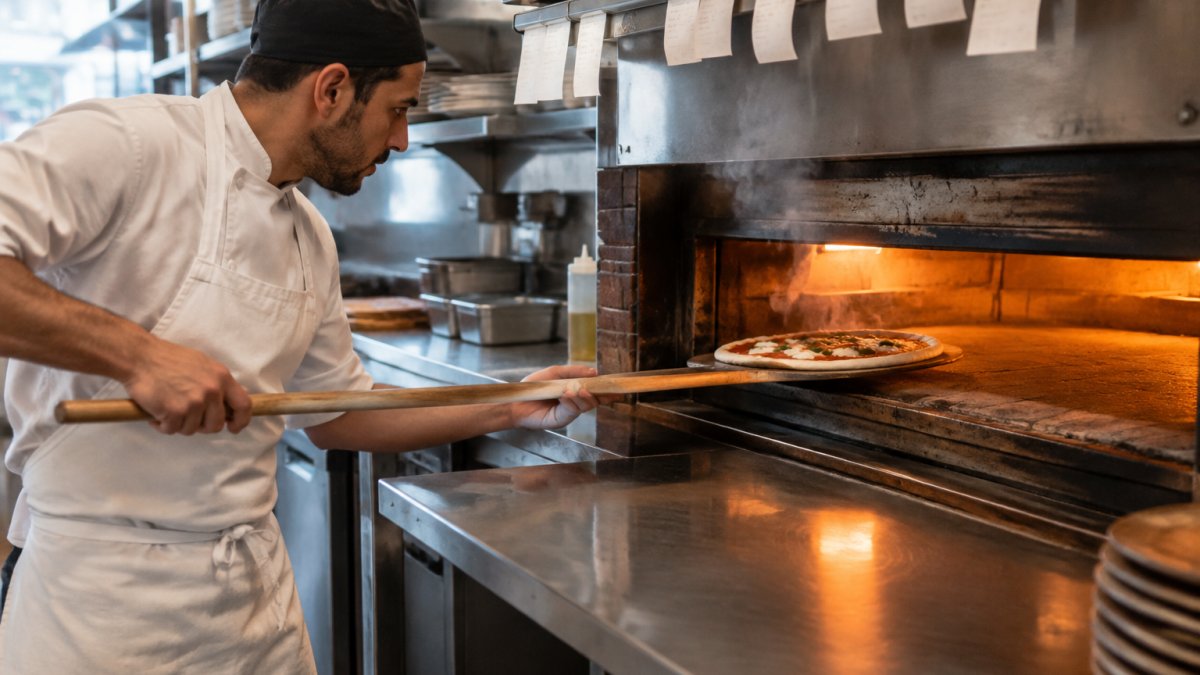
Most ovens are rated by maximum temperature, not their ability to hold heat under load. A 2026 commercial guide from Southern Select's high-volume oven guide describes high-volume ovens as built for 100 to 500 pizzas per hour, against roughly 50 per hour for a boutique shop.
A 2023 study in PubMed Central on Neapolitan pizza baking measured a maximum pizza-bottom temperature of 100 ± 9°C.
Every pizza you launch pulls heat out of the deck, and so does every door opening.
Most guides treat oven temperature as a single setting.
Commercial Pizza Oven Temperature Targets for Peak Service
For peak service, floor temperature targets vary by style. New York-style pies and Neapolitan pies call for different floor ranges, and the dome and air above the deck usually read higher than the floor.
Those targets only hold if the oven has enough thermal mass to absorb cold dough without crashing. A high-volume oven needs stored heat to cook a cold pie fast without its internal temperature dropping after each one, according to Southern Select's throughput guide.
You can browse commercial pizza ovens whose specs match these targets before you commit to a number.
Floor, Dome, and Air: Three Readings That Matter
Floor temperature sets how fast the bottom sets and browns. Dome temperature drives the top and the char. Air temperature inside the chamber governs how evenly the whole pie cooks.
A 2026 piece from Bighorn Outdoor on oven temperature control makes a sharp point: maximum temperature is an easy starting point when comparing ovens, but it does not capture everything that matters.
Track all three readings with an infrared thermometer. If the floor runs hot and the dome runs cold, you get a burnt bottom and a pale top. If the dome runs hot and the floor runs cold, the reverse.
Recovery Time Between Consecutive Pizzas
Recovery time is the minutes your deck needs to climb back to target after a pie comes out. It decides your real throughput, and almost no spec sheet lists it.
Test it yourself. Take a floor reading, launch a pie, pull it, then read the floor every 30 seconds until it returns to target.
Plan your launch cadence around that number, not around your oven's rated hourly capacity.
Wood-Fired Pizza Oven Temperature and Time Under Load
A wood-fired pizza oven temperature runs hot and uneven, and that unevenness worsens when tickets stack up. Expect 750°F to 900°F on the floor near the fire, cooler toward the mouth, and a live flame that shifts the dome reading minute by minute.
Live fire gives you speed but not stability. The flame licks one side of the dome, so rotate each pie a quarter turn every 15 to 20 seconds. Skip the turn and one edge chars while the other stays pale.
How the Fire Cools Under Consecutive Launches
Every pizza you launch pulls heat from the floor, and every door opening pulls heat from the dome and air.
Keep the door closed between launches, since opening it dumps heat. Add smaller fuel pieces more often rather than a large log during a rush.
Watch out: banking too many embers under the floor to chase a fast recovery will push the floor past 900°F and char the bottom before the top sets.
Rotation Cadence and Launch Spacing During Peak Service
In a wood-fired oven, rotation cadence and launch spacing are the same decision. If you launch a pie every 90 seconds, you have roughly 90 seconds to turn it four times, pull it, and reset the peel. If your bake is a true 60-second Neapolitan, the margin is tighter and the fire has less time to recover between pies.
Staging launches so no two pies go in back-to-back without a short gap gives the floor a chance to recover between pies.
Fuel, Staffing, and the Real Cost of Live Fire
Wood also demands attention. Someone has to feed the fire while the line is slammed, and that person cannot also stretch dough or work the register. That is a staffing cost, not just a fuel cost.
If you want high heat without tending a fire, a deck oven with stone decks is the practical alternative. The PizzaMaster PM 842ED two-deck electric deck oven reaches 932°F with ceramic clay stones and separate top, bottom, and front heat zones, so you can adjust the floor and dome independently.

Gas Pizza Oven Temperature: Holding Steady When Orders Stack Up
Gas pizza oven temperature is easier to hold than wood, because the burner responds to a thermostat instead of a log.
Thick sealed walls and a modulating burner that adjusts flame help a gas oven hold heat.
The Rosito Bisani Morello Forni PG130-CB gas-fired round oven pairs a 51-inch cooking chamber with 7-inch sealed insulated walls and a thermostat-and-flame-modulator burner system.

Pizza Oven Temperature and Bake Time: Matching Heat to Style
Pizza oven temperature and bake time move together. Hotter ovens bake faster, and the style you sell decides which pairing you need.
A Neapolitan pie wants 800°F to 900°F and a 60 to 90-second bake. A New York slice wants 550°F to 650°F and a 6 to 10-minute bake. Push a New York dough into Neapolitan heat and the crust chars before the center sets.
Neapolitan, New York, and Everything In Between
Match your dough, your target texture, and your oven to the same style. Here is the working range we recommend:
| Style | Floor Temp | Bake Time | Crust Result |
|---|---|---|---|
| Neapolitan | 800-900°F | 60-90 seconds | Puffy, leopard-spotted char |
| New York | 550-650°F | 6-10 minutes | Crisp, foldable, even brown |
| Detroit / pan | 500-550°F | 12-15 minutes | Crisp cheese edge, airy crumb |
| Bar / tavern | 500-550°F | 5-8 minutes | Thin, cracker-crisp |
Floor Temp
Use this as a starting grid, then adjust for your dough hydration and your oven's recovery speed. A style that bakes fast leaves less room for error when the floor cools mid-rush.
If you are still weighing whether a pizza oven belongs in your kitchen, read is the pizza oven worth it for your commercial kitchen before you spend.
Monitoring and Troubleshooting Uneven Bakes Mid-Service
Uneven bakes during a rush almost always trace to one of four causes, and the fix depends on which reading is off. Most kitchens check temperature once before service and never look again until something burns. During a dinner rush, the oven is a moving target, and monitoring has to be a cadence, not a checklist item.
A Monitoring Cadence That Survives Peak Service
Take a floor, dome, and air reading at the start of every shift and log them.
Use an infrared thermometer for surface readings, but aim it correctly. The floor reading should come from the center of the deck, not near the door where heat leaks out.
Watch out: an infrared thermometer reads surface temperature, not air temperature, and a shiny or reflective stone surface can give a misleadingly low reading.
Troubleshooting by Symptom, Not by Guess
- Burnt bottom, pale top: floor too hot, dome too cool. Lower the bottom zone and raise the top. In a wood-fired oven, spread the embers thinner and add flame to the dome side.
- Pale bottom, burnt top: the reverse. The floor lost heat and the dome is running hot. Rebuild the ember bed or raise the bottom zone, and reduce the top flame.
- One side charred: the pie sat too long without a turn. Rotate every 15 to 20 seconds, and check whether the launch position is too close to the fire.
Calibration and the Drift Threshold
Calibrate before service, not during it. A drift of 25°F or more from your target means it is time to check the burner, the stone, or the fuel bed.
Watch out: pulling a pie early to "fix" a hot floor just moves the problem to the next order. Fix the heat, not the timer.
If a bake keeps going wrong and the readings look fine, the problem may be the launch position or the dough temperature rather than the oven. Reach out through How Can We Help and we will work through the setup with you.
A dinner rush exposes every weakness in an oven, and temperature control is where most kitchens lose consistency.
Frequently Asked Questions
What temperature should a commercial pizza oven be during a dinner rush?
Floor temperature during peak service depends on your style and oven, and the dome or top zone often runs hotter than the floor. The exact number depends on your style: New York slices usually want a 6-to-8-minute bake, so a slightly lower floor helps the crust set before the bottom chars. Check the floor with an infrared thermometer between pies, not just the display readout, because air temperature and baking surface temperature can differ by 50°F or more.
How long does a commercial pizza oven take to recover between pizzas?
Recovery depends on thermal mass and how much heat the deck lost when the door opened. A deck with thick ceramic stones and high-density insulation holds its floor temperature far better than a thin-stone unit. Rather than guessing, time it: bake one pie, close the door, then re-read the floor every 30 seconds until it returns to target. If recovery takes longer than your ticket interval, you either need to stagger launches or run a lower volume per deck.
Is 500 degrees too hot for pizza?
Not for a commercial deck or wood-fired oven, where 500°F is often the minimum for a fast bake. At home, 500°F is usually the top of the dial and works well for a 6-to-8-minute pie on a preheated stone. The number matters less than the balance between floor and top heat. A 500°F floor with weak top heat gives you a pale top and a burnt bottom, so adjust the top zone before you change the overall setpoint.
Should you change oven temperature when the dinner rush starts?
Usually not. Drop the setpoint at the start of service and you spend the first 20 minutes chasing heat while tickets pile up. Instead, preheat past your target before the rush so the deck has stored heat to give back, then hold steady. If your oven has separate top, bottom, and front zones, make small adjustments to those zones rather than the master temperature, and give each change a full bake cycle before judging it.


