


Commercial Kitchen Equipment Durability for High-Volume Kitchens
Quick Summary
Commercial kitchen equipment durability means keeping consistent output through long shifts, peak service and daily cleaning without losing performance. Judge it by whether the unit holds its rated output, recovers quickly after heavy use, and fails gradually rather than without warning.
- Start durability reviews with core appliances like ovens, mixers, refrigeration and steam equipment, since their failure stops service.
- Size equipment to your busiest hour, not the average day, and add a 20 to 30 percent surge margin.
- Compare total cost of ownership over five years, including energy, water, repairs and downtime, not just purchase price.
- Train staff on equipment use, since careless operation causes early failure even in well-built units.
- Follow a fixed preventive maintenance schedule and replace wear parts before they fail.
Table of Contents
- What Durability Means in a High-Volume Commercial Kitchen
- Commercial Kitchen Equipment List: The Core Appliances That Carry Your Volume
- How Long Does Commercial Kitchen Equipment Last Under Heavy Use?
- How to Tell Whether Equipment Is Built for Heavy Use
- Total Cost of Ownership: Pricing Versus Downtime
- Capacity Planning Using Measurable Throughput
- Best Commercial Kitchen Equipment for High-Volume Kitchens
- Commercial Kitchen Equipment Maintenance Schedules That Prevent Failures
- Choosing Your Next Piece of Equipment for Sustained Output
- Frequently Asked Questions
What Durability Means in a High-Volume Commercial Kitchen
Last Updated: November 10, 2026
Durability in a commercial kitchen is not the same as build quality on a spec sheet. In a high-volume kitchen, durability means equipment keeps producing consistent output through long shifts, peak service and daily cleaning cycles without losing performance. At Crestoven, we define it by three measurable questions: does the unit hold its rated output, does it recover quickly after heavy use, and does it fail gradually or without warning?
Energy and water use shape durability too. The U.S. Department of Energy notes that water efficiency matters especially in high-volume applications, where equipment typically draws mostly hot water U.S. Department of Energy guidance on commercial kitchen equipment water efficiency. Equipment that runs hard and wastes utilities puts strain on the rest of the line.
Staff habits matter as much as hardware. A California Energy Commission study of commercial cooking equipment and kitchen ventilation found that staff behavior, especially equipment training, was critical to how well equipment performed California Energy Commission study on efficient commercial cooking equipment and kitchen ventilation. A well-built oven operated carelessly will still fail early.
Commercial Kitchen Equipment List: The Core Appliances That Carry Your Volume
The core appliances in a high-volume kitchen are the ones that stop service when they fail: ovens, mixers, refrigeration, and steam or cooking equipment. Start your durability review with these, because a single failure here cascades across the whole line.
Pizza and deck ovens, dough mixers, prep refrigeration, and convection steamers carry most of the load in slice shops, bakeries and catering operations. Crest Oven's product lineup includes the PizzaMaster PM 842ED two-deck electric oven and the Hobart HSL180-1 spiral mixer.
How Long Does Commercial Kitchen Equipment Last Under Heavy Use?
Service life depends on duty cycle, maintenance and build quality, and published lifespan figures vary widely by category. Published lifespan figures vary widely by category, so treat any single number with caution. Instead, judge equipment by its duty rating and warranty terms, and ask the supplier how the unit is expected to behave at your actual daily volume.
How to Tell Whether Equipment Is Built for Heavy Use
Consider the rated duty alongside the price. Equipment built for sustained output typically lists its capacity in hard numbers, such as the 180 lb dough capacity and 6.0 HP spiral arm motor of the Hobart HSL180-1.
Construction, Motors, and Insulation to Inspect
Check the bowl, frame and motor specs. Stainless steel bowls, heavy-gauge frames and motors sized for the load resist wear. Insulation matters on ovens and refrigeration, because it holds temperature when doors open during a rush.
Warranty, Parts Availability, and Service Response
Ask how quickly parts ship and who services the unit. Downtime during service is the real cost, so a short, clear warranty and a responsive support path count as durability features.
Total Cost of Ownership: Pricing Versus Downtime
Sticker price is the most visible number in an equipment decision, and it is usually the least informative. A unit priced at a few thousand dollars less can cost more over five years once repair calls, energy bills, water use and lost service hours are added up. The goal of a total cost of ownership comparison is to put every recurring cost on the same timeline so two units can be compared on equal terms.
Start with five inputs for each candidate unit:
- Purchase price, including delivery and installation. Quote this in USD, and include any required electrical, gas or plumbing work. Many buyers forget that a high-output oven or dishwasher can require a larger circuit or a dedicated water line, and those costs belong in year one.
- Expected annual energy cost. Use the rated energy input from the spec sheet and your actual operating hours. A fryer that idles for six hours a day consumes energy even when no food is cooking, so ask the supplier for idle consumption figures where they are published.
- Water use. For dishwashers, steamers and combi ovens, water consumption often rivals energy as an operating cost. Multiply rated gallons per cycle by cycles per day and by your local water rate.
- Expected repair frequency and parts cost. Ask the dealer for typical repair frequency on the model, and check whether common wear parts such as gaskets, heating elements, fan motors and door hinges are stocked locally.
- Downtime exposure. Estimate what one service day costs you. If a single failed mixer stops your bread production for a day, the lost sales and the labor you still pay for can exceed the repair invoice many times over.
A simple way to organize the comparison is a five-year cost sheet with one column per unit. Add purchase price in year one, then add annual energy, water, expected repairs and estimated downtime cost in each year, and total the columns. Include a residual value line if you plan to sell or trade the equipment, though used commercial equipment resale values are highly variable and should not be assumed.
Watch out: a low-cost unit with a short warranty or no local service technician can look cheap on paper and expensive once a repair takes several days to schedule, because the downtime cost is often larger than every line item above combined.
The comparison works best when you use your own volume and utility rates rather than generic averages. A unit that uses less water per cycle matters more in a kitchen running ten dishwasher cycles an hour than in one running two, and the spreadsheet should reflect that difference.
Capacity Planning Using Measurable Throughput
Most undersized equipment problems come from sizing a kitchen to the average day instead of the busiest hour. A high-volume operation can run at a manageable pace for most of the day and then hit a wall during a short window when orders stack up. Capacity planning converts that peak into numbers that can be matched against each appliance's rated output.
The method has four steps.
Step 1: Measure peak demand. Pull your order data for the busiest hour of a typical week, not a holiday or an unusually slow Tuesday. Count orders or covers for that hour, then count the individual items within those orders. A pizza shop should count pizzas by size and style, a bakery should count loaves and rolls by dough type, and a caterer should count pans by product.
Step 2: Convert demand into batches. Divide each product's peak-hour count by the number of units a single batch produces. For example, if a mixer's rated capacity supports a batch that yields a set number of dough balls, divide the peak-hour dough balls by that number to find batches needed per hour. Then compare that figure against how many batches the mixer can complete in an hour, including bowl loading, mixing time, discharge and cleaning time between batches. Rated batch size and real cycle time are different numbers, and the cycle time usually determines throughput.
Step 3: Check the bottleneck. Repeat the calculation for every station that feeds the peak product, including prep refrigeration, proofing, oven deck capacity and holding equipment. The effective output of the line is set by the slowest station, so a fast oven cannot compensate for a mixer that falls behind.
Step 4: Add a surge margin. Most operators add 20 to 30 percent above measured peak demand to absorb promotions, weather-driven surges and staff absences. The right margin depends on how predictable your volume is, and it should be reviewed after any menu change.
A worked example makes the method concrete. Suppose a bakery sells 240 loaves between 7:00 and 8:00 a.m., and each batch of dough produces 40 loaves with an effective mixer cycle of 15 minutes including loading and cleaning. The bakery needs six batches in that hour, but a single mixer can complete only four. Adding a 25 percent surge margin pushes the requirement to about seven and a half batches, which points to a second mixer or a shift in production timing rather than a larger single unit.
Rated capacity on a spec sheet is often measured under ideal conditions, so timing a real batch during service can help validate throughput before purchase.
Run this calculation for each product line before comparing equipment models. The result is a set of defensible numbers you can show a supplier, a lender or a business partner, which is more useful than a general recommendation that a unit is "heavy-duty."
The four steps below turn peak demand into numbers you can check against each appliance's output.
| Step | What to do | Time or margin |
|---|---|---|
| Measure peak demand | Count orders or items for the busiest hour | Typical week, busiest hour |
| Convert demand into batches | Divide peak-hour count by units per batch | Include cycle time per batch |
| Check the bottleneck | Repeat for every station feeding the peak product | Slowest station sets output |
| Add a surge margin | Add margin above measured peak demand | 20 to 30 percent |
Best Commercial Kitchen Equipment for High-Volume Kitchens
The Hobart HSL180-1 is a heavy-duty spiral mixer with dual electronic timers and a reversible bowl drive. The Empire Bakery Equipment EMP-IRIS-100 is a fixed-bowl spiral mixer with two speeds and 109 lb bagel or 133 lb bread-flour capacity. The PizzaMaster PM 842ED provides a 64.6 x 32.3-inch baking surface across two decks.
Best for: slice shops and bakeries running continuous batches. Skip if: your output is modest and a smaller countertop unit covers your volume.
Commercial Kitchen Equipment Maintenance Schedules That Prevent Failures
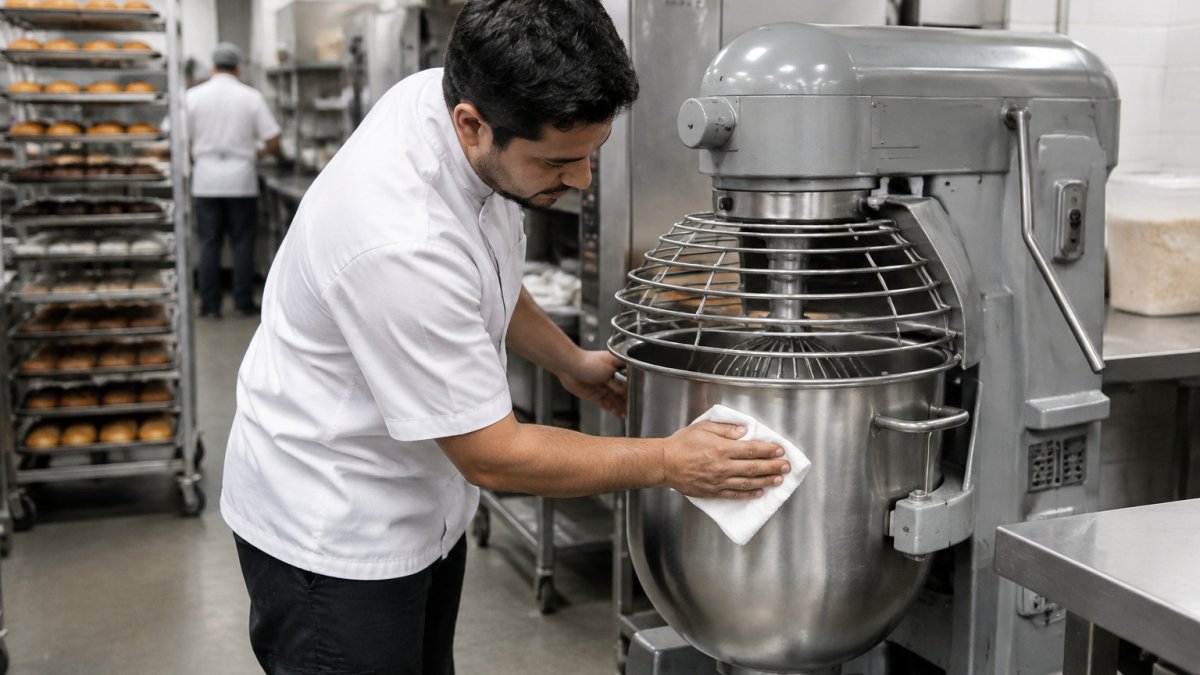
Preventive maintenance is among the most cost-effective durability tools available. Clean and inspect mixers, ovens and refrigeration on a fixed schedule, log every service visit, and replace wear parts before they fail. Train staff to report unusual noises or temperature drift early, since the California Energy Commission research points to training as central to equipment performance California Energy Commission study on efficient commercial cooking equipment and kitchen ventilation.
Choosing Your Next Piece of Equipment for Sustained Output
Start with your peak-hour volume, match each appliance's rated duty to it, and compare warranty and parts support alongside price. If you want to see how high-volume equipment is built, browse our commercial dough mixers or read our guide to choosing a dough mixer before you decide. A contact page is also available if you want advice on sizing a setup for your kitchen.
Crestoven builds equipment for the demands of high-volume service, with independent dual decks and 6,400W heating power on our ovens. Get started with the right setup for your kitchen and keep your line running through peak service.
Frequently Asked Questions
What are the most durable commercial kitchen appliances?
Durability depends on how the equipment is built and how hard it is worked. Heavy-duty spiral dough mixers with stainless steel bowls and robust drive motors, deck ovens with high-density insulation, and prep refrigeration with solid compressors tend to hold up best under sustained volume. When comparing models, look at construction materials, motor ratings, and the manufacturer's warranty and service network. Equipment rated for continuous commercial use will generally outlast residential-grade alternatives used in the same setting.
How long does commercial kitchen equipment last?
Service life varies by equipment type, duty cycle, and maintenance. Well-maintained commercial equipment operating in a high-volume kitchen often runs for many years, while neglected units can fail much sooner. Heavy daily use shortens the lifespan of components such as heating elements, bearings, gaskets, and compressors. Tracking preventive maintenance and addressing small issues early is the most reliable way to extend service life and avoid unplanned downtime during peak service.
How can you tell whether commercial kitchen equipment is built for heavy use?
Inspect the materials first. Stainless steel construction, heavy-gauge metal panels, and sealed controls indicate commercial-grade build quality. Check motor horsepower and duty ratings against your expected batch sizes, and confirm insulation quality on ovens and refrigeration. Review the warranty length, parts availability, and the manufacturer's service response time. Equipment that is specified for continuous operation under real commercial demand is a stronger choice than units built for intermittent use.
How do you maintain commercial kitchen equipment to extend its lifespan?
Build a schedule that matches how often each unit runs. Daily tasks usually include cleaning surfaces, checking seals and gaskets, and clearing debris from vents and filters. Weekly and monthly tasks include inspecting motors and belts, verifying temperature calibration on ovens and refrigeration, and lubricating moving parts as the manufacturer specifies. Keep a service log so you can spot recurring faults early. Preventive maintenance costs far less than emergency repairs during service.
What commercial kitchen equipment should a high-volume restaurant prioritize?
Prioritize the equipment that limits your throughput. In most high-volume kitchens, this means cooking equipment such as ovens, the dough mixers that feed production, and refrigeration that holds prep stock at safe temperatures. Evaluate each piece by its rated capacity, duty cycle, and the cost of downtime if it fails. Equipment that stops the entire line deserves the strongest build specification and the most reliable service support.


